
Selling a Classic Six on the Upper East Side: Pricing, Boards and Timing in 2026
This guide is for owners of a pre-war classic six co-op on the Upper East Side who are weighing a sale. It covers what buyers mean by a classic six and how they value one, why the co-op and condo markets have been moving on different tracks in 2026, and how to set a price when the nearest comparison is often a condo a few blocks away. It then walks through the board side of the sale, including New York City's new co-op application timeline law and the Local Law 97 questions buyers now raise, and closes with the order of operations we follow to take a classic six from first conversation to closing. Market figures come from Jonathan Miller, Olshan Realty and StreetEasy.
What a Classic Six Is and Why Buyers Still Want One
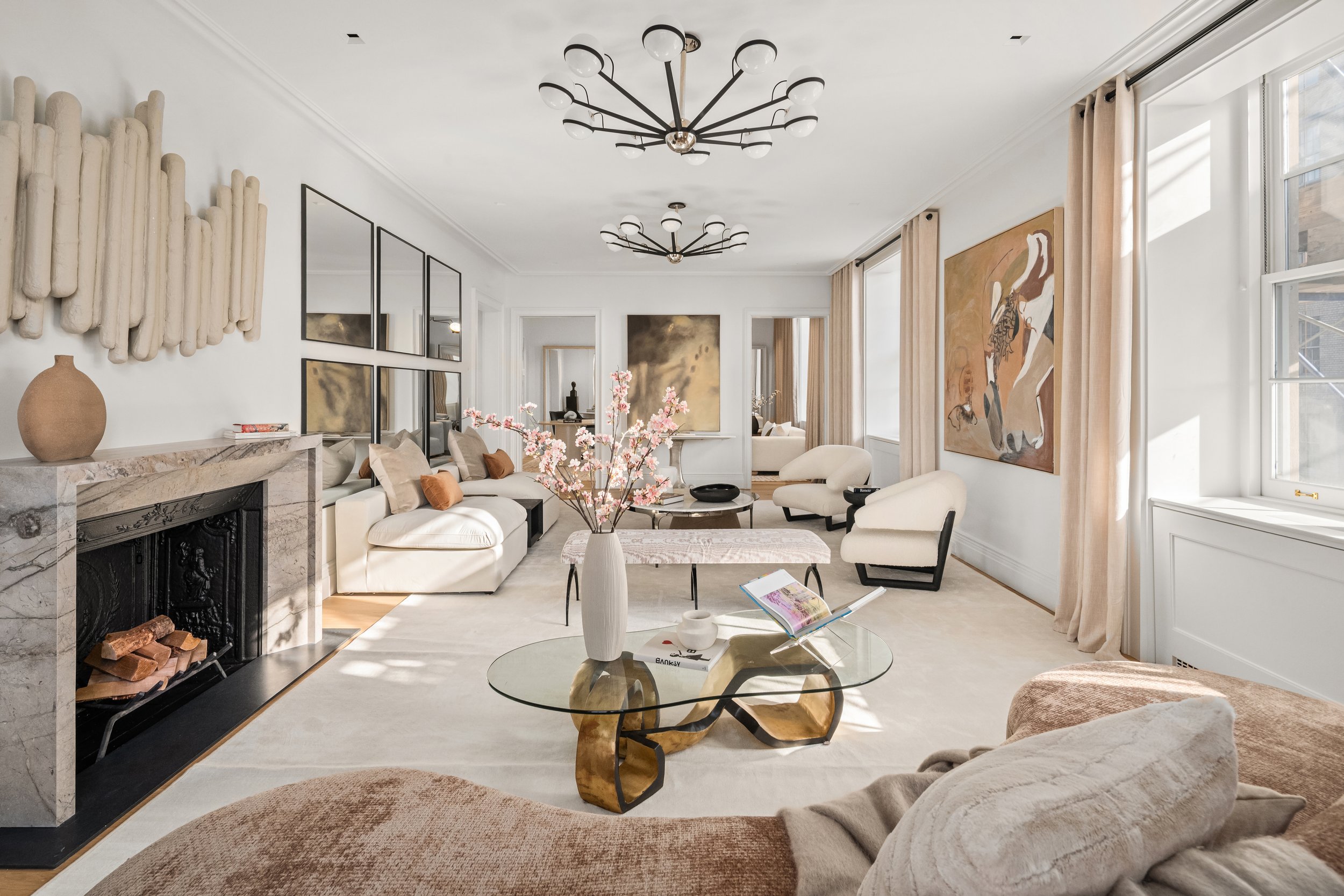
A classic six is a pre-war co-op layout with six principal rooms: a living room, a formal dining room, a kitchen, two bedrooms and a maid's room. On the Upper East Side, most sit in limestone and brick buildings on Fifth, Park, Madison and Lexington Avenues and the side streets between them, built in the 1910s and 1920s with high ceilings, plaster walls, wood-burning fireplaces in many cases, and a clear separation between entertaining rooms and private rooms.
That plan is the reason the apartment sells. Buyers get a gallery, a true dining room and a flexible third room in a doorman building with a long operating history. Our guide to the best pre-war co-ops on the Upper East Side covers the buildings where this layout is most common, including 740 Park Avenue and 960 Fifth Avenue, where the grander versions of the plan run to classic eights, tens and beyond.
Co-ops and Condos Are Not Moving Together in 2026
Jonathan Miller's third quarter 2026 Manhattan sales report, published with The Real Deal on October 2, shows the overall median holding at a record $1,250,000 for a second straight quarter. Underneath that headline, the two property types diverged. Co-op prices for the larger apartment sizes rose sharply, while condo prices in the same size ranges slipped.
| Manhattan, Q3 2026 | Co-ops | Condos |
|---|---|---|
| Median sales price | $900,000, up 3.4% year over year | $1,797,000, up 8.9% |
| Average price per square foot | $1,217, up 4.0% | $1,935, down 3.2% |
| Median price, 2-bedroom | $1,611,831, up 25.4% | $2,054,450, down 4.4% |
| Median price, 3-bedroom | $2,792,708, up 28.6% | $3,754,165, down 4.2% |
| Closed sales | 1,864, up 6.5% | 1,548, up 10.0% |
| Days on market | 84 | 104 |
| Listing discount | 1.5% | 3.9% |
| Listing inventory | 3,235, down 11.8% | 3,674, down 9.6% |
| Months of supply | 5.2 | 7.1 |
For a classic six owner, the size rows matter more than the overall median. Co-op two-bedroom and three-bedroom medians were up roughly a quarter from a year earlier, while the condo medians for the same sizes were down about 4%. Co-ops also sold faster, closer to their last asking price, and against a thinner supply of competing listings. Medians shift with the mix of what sold in a given quarter, so these figures show the direction of the market, and any one apartment is priced on its own comparables. Miller's own summary notes that most of the year's price growth came in two- and three-bedroom apartments and that the strongest sales growth was from $2 million to $5 million, which is where a large share of Upper East Side classic sixes trade. Brick Underground, covering the quarter on {a(BU,'October 2')}, cited a Compass report showing condo and co-op deals from $3 million to $5 million up more than 30%.
The weekly contract data at the top of the market tells a related story. In June, luxury co-ops outsold condos at $4 million and above in Olshan Realty's weekly report for the first time in about four years. Condos have since resumed their usual lead, and co-ops have held a steady share: Olshan counted 7 co-ops against 21 condos for September 28 to October 4, 6 against 15 for October 5 to 11, 7 against 17 for October 12 to 18, and 13 against 19 for October 19 to 25, the busiest week for luxury contracts in 20 weeks.
How Buyers Value a Classic Six
Two classic sixes in the same building can sell for very different prices, and the gap usually comes down to a handful of factors that buyers and their appraisers weigh closely.
Renovation state:
A fully renovated kitchen and baths with updated wiring and plumbing reach the widest pool of buyers. An original-condition apartment appeals to buyers who want to renovate, and they will price in the cost, the board's alteration process and the time it takes.
Floor, light and outlook:
High floors with open views over Fifth Avenue, Park Avenue or a wide side street command a premium over low floors facing a court.
Maintenance and flip tax:
Buyers compare monthly maintenance across buildings and ask who pays the flip tax and how it is calculated.
Financing allowed:
Some buildings permit financing up to a set percentage of the price, and some require all cash. That rule decides how many buyers can make an offer.
Board financial requirements:
Post-closing liquidity requirements and debt-to-income limits narrow the buyer pool further, and the strictest buildings are known for them.
Carrying costs are rising across the market, which makes the monthly figure part of the pricing conversation. In Miller's second quarter 2026 report, the median monthly maintenance on a Manhattan co-op sale was $3,077, or $2.83 per square foot, up 10.2% and 16% from a year earlier. Condo common charges plus real estate taxes were $4,466 a month, or $3.37 per square foot. A classic six in a building with well-managed maintenance and no recent assessments is easier to price at the top of its range.
Pricing a Classic Six Against Nearby Condos
Many buyers touring classic sixes are also looking at resale condos on the same blocks and in newer buildings to the east. Co-ops still sell for less per square foot. Miller's third quarter average was $1,217 per square foot for co-ops and $1,935 for condos across Manhattan, and that gap is a pricing tool for the seller when it is framed well.
Supply is also shifting. StreetEasy reported that the Upper East Side had 603 new listings in September, up 17.5% from a year earlier and the most of any neighborhood it tracked, with a median asking price of $1,395,000 for those new listings. StreetEasy also reported that resale condos drove the rise in new Manhattan listings, up 15.8%. More condo choices near a classic six means the co-op seller should price with the condo alternatives in view, presenting the room count, ceiling heights, layout and lower price per square foot as the case for the apartment.
Rates are a factor too. The Real Deal reported on October 2 that the average 30-year fixed mortgage reached 7.28%, its highest level in three years, and Miller noted that buyers below $1 million are the most rate sensitive while luxury buyers are mostly paying cash. A classic six in a building that allows financing still draws buyers who borrow, so the building's financing rule should shape both the price and the marketing. Our piece on why the first 21 days decide your sale price explains why the opening number matters so much.
The Board Process Now Runs on a Legal Clock
Since July 28, 2026, Local Law 58 of 2026, which began as Intro 1120-B in the City Council, has put deadlines on co-op purchase applications in buildings with 10 or more residential units. As Fox Rothschild partner Julie Schechter explained to CooperatorNews, the board has 15 days to tell the buyer in writing whether the package is complete and, if not, exactly what is missing. A package the board does not respond to is deemed complete. The board then has 45 days to approve, conditionally approve or deny, with one extension of up to 14 days and further extensions only with the buyer's consent. Boards that adopt a written summer recess policy in advance can toll the clock in July and August.
For sellers, the law turns the board stage from an open-ended wait into a predictable window. It does not change what a board can ask for or the grounds on which it can decline a buyer, and HPD fines for missed deadlines are paid to the city. A complete, well-organized package is now worth even more, because it starts the clock cleanly. Our guide to the co-op application timeline law covers the details.
Local Law 97 and Facade Questions Buyers Now Ask
Buyers and their attorneys now ask about the building's position under Local Law 97, the city's carbon emissions law for buildings over 25,000 square feet. The early news is reassuring. Habitat reported on September 15, 2026 that about 95% of market-rate buildings covered by the law, including large co-ops and condos, have met the first limits or taken steps to, according to a Department of Buildings report. Habitat also reported that limits tighten in 2030, that many co-ops and condos will likely need more expensive retrofits, and that buildings over the limit face fines of $268 per ton of excess emissions each year.
A seller can get ahead of these questions by asking the managing agent for the building's compliance status and any engineering or capital plan the board has adopted, along with the latest facade inspection under Local Law 11, which our Local Law 11 guide explains. Clear answers in the diligence file keep the deal moving.
The Order of Operations for a Classic Six Sale
We sell classic sixes in a set order so that price, presentation and paperwork are ready before the first showing.
First, we price against recent co-op sales of the same layout in comparable buildings and then test that number against the condo alternatives a buyer will see. Second, we prepare the apartment, which can mean light repairs, paint and staging of the dining room and maid's room so buyers read the plan correctly. Third, we assemble the board-side materials early: the building's financials, the board application and its requirements, the financing and liquidity rules, the flip tax terms, any summer recess policy and the Local Law 97 and facade documents. Fourth, we choose the launch, which can be a quiet off-market process for qualified buyers, a full public launch, or a sequence of the two, as our seller playbook describes.
Before listing, run your numbers through our NYC seller closing cost calculator so the flip tax, transfer taxes and other costs are clear from the start. Our co-op or condo decision framework shows how buyers compare the two, which helps anticipate their questions. Eric Brown and Zeve Salman lead every sale personally, including pre-war Fifth Avenue co-op work such as our transaction at 1060 Fifth Avenue. If you are considering selling a classic six on the Upper East Side, contact us for a private conversation about pricing and timing.
Work with Elevated
We have helped clients buy and sell residences in nearly every notable building throughout New York City, including 443 Greenwich, 70 Vestry, 56 Leonard, 111 Murray, 71 Laight, and 80 Clarkson, among many others. We are also proud to have represented the most expensive penthouse ever sold in Downtown Manhattan, a $60 million residence at 150 Charles Street. More than half of our transactions take place off-market, as many of the best opportunities never reach a public listing site. Talk to us before you bid. We can help you understand not only what to buy, but how a building actually operates, how it is perceived in the market, and what you should know before making an offer.
Elevated Advisement
Considering a move?
Tell us what you are looking for and we will come back to you privately, including off-market options that never reach the public listings.
Message sent
Thanks for reaching out. We will be in touch personally.